The Art and Effort Behind Our AI Visuals
Beyond the Prompt
Written by
Design Lead
In the current digital landscape, there is a common misconception that "AI-generated" means "instant." To some, it looks like typing a few words into a box and receiving a finished masterpiece seconds later. At UCAN, we see it differently. For us, AI isn’t a shortcut; it’s a high-performance engine that requires an expert driver. Creating a professional, brand-aligned visual is an intricate, multi-stage process that blends advanced linguistic engineering, multi-model collaboration, and hours of traditional digital craftsmanship.
1. The Architectural Phase: Multi-Model Prompting
We don’t start by talking to an image generator. We start by talking to the world’s most advanced Large Language Models (LLMs) to build a "visual blueprint."
Claude for Creative Nuance: We often use Claude to brainstorm the emotional and narrative depth of a visual. Claude’s ability to understand brand voice and complex metaphors helps us define the vibe before a single pixel is rendered.
Gemini for Technical Precision: We then pivot to Gemini to translate those creative concepts into technical specifications. Gemini’s strength in structured data helps us define lighting parameters, lens types (like a 35mm f/1.4), and architectural accuracy.
By bouncing ideas between these different models, we develop a "Master Prompt"—a highly sophisticated paragraph of code and prose that serves as the foundation for the image.
2. The Iteration Loop: Finding the Diamond
Once we have our blueprint, we move to the generation phase. This is rarely a "one-and-done" event.
We may generate 50, 100, or even 200 variations of a single concept. We adjust the "weight" of certain words, swap out lighting styles, and experiment with different AI seeds. This stage is about curation. It takes a human eye—trained in art direction and composition—to spot the one image that has the potential to represent your brand.
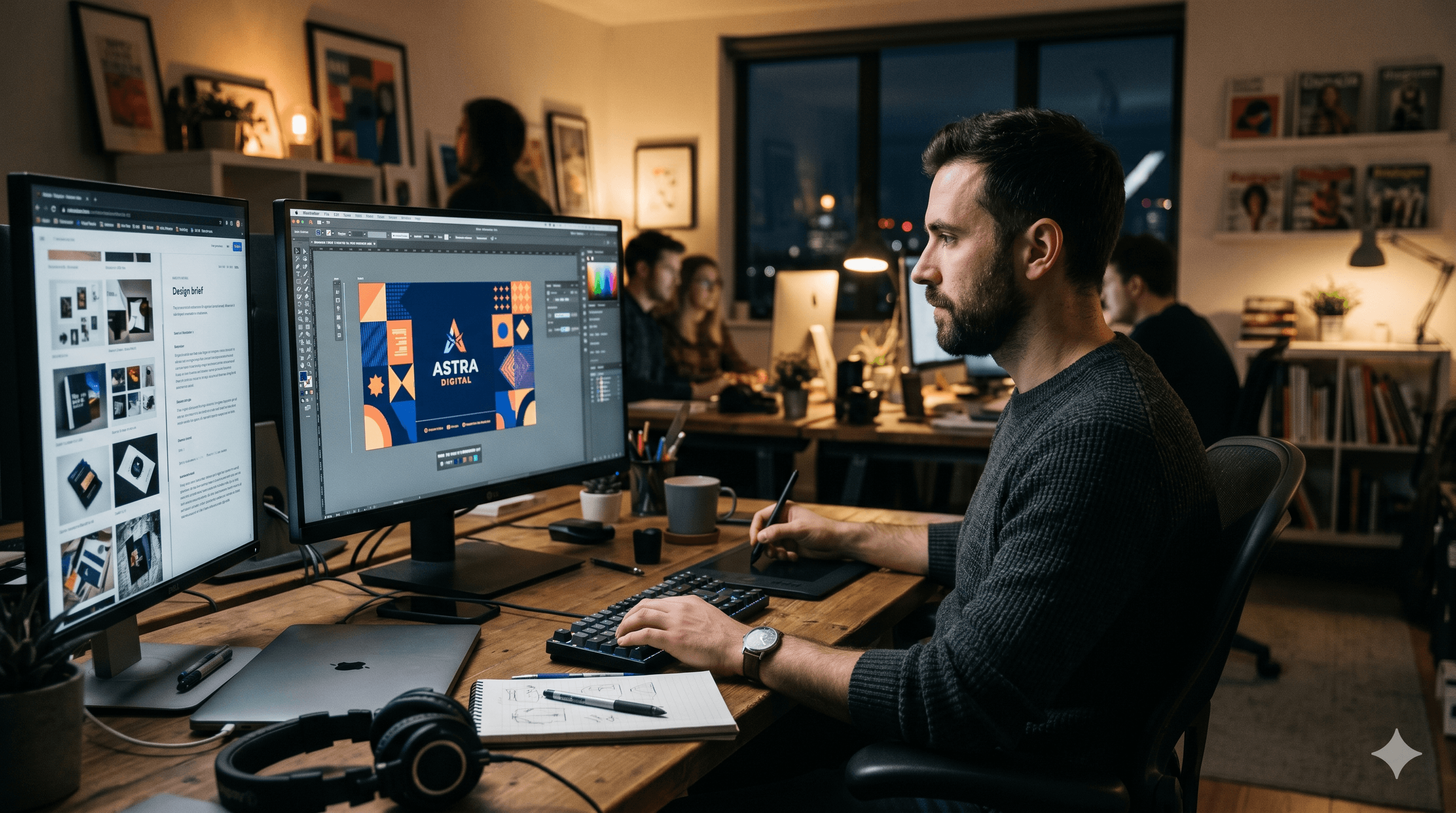
3. The Digital Darkroom: Photoshop and Post-Production
An AI-generated image is a raw diamond; it still needs to be cut and polished. AI often struggles with the "last 10%"—a stray finger, a warped logo, or a lighting inconsistency.
This is where the heavy lifting happens. Our designers take the base AI render into Adobe Photoshop for a rigorous post-production process:
Generative Fill & In-painting: We manually correct AI artifacts and add specific brand elements that the model couldn't handle on its own.
Color Grading: We apply custom LUTs and curves to ensure the image matches your brand’s specific color palette.
Compositional Tweaks: We often composite elements from three or four different AI generations into one "perfect" final frame.
Why This Matters for Your Brand
When you work with us, you aren’t paying for a "prompt." You are paying for a workflow.
By combining the linguistic intelligence of Claude and Gemini with the precision of professional photo editing, we deliver visuals that are unique, legally compliant, and—most importantly—impossible to replicate with a simple "1 or 2 prompts."